


Why Pausing Strength Training for Another Season Is Costing Your Athlete More Than You Think

Updated: 1 minute ago
The Text Message We Get Every Season...
It usually shows up in the same week as the new season schedule.
“We’re going to pause classes for a while. She made the travel team, and practices are Tuesday and Thursday now.”
“He’s doing fall ball plus club soccer, so we just don’t have room right now.”
“We’ll be back after the season.”
We understand it completely. You are looking at a calendar already packed with homework, two practices, a Saturday tournament, and a 40-minute drive, and strength and conditioning training looks like the one thing you can safely subtract. More field time, more court time, more reps at the actual sport- that's what develops your athlete, right?
That instinct is exactly the mistake. It's the single most common reason talented kids stop progressing right when the separation begins.
Practice Makes Them Better at the Sport. Training Makes Them a Better Athlete.
These are two different jobs, and one cannot do the other’s work.

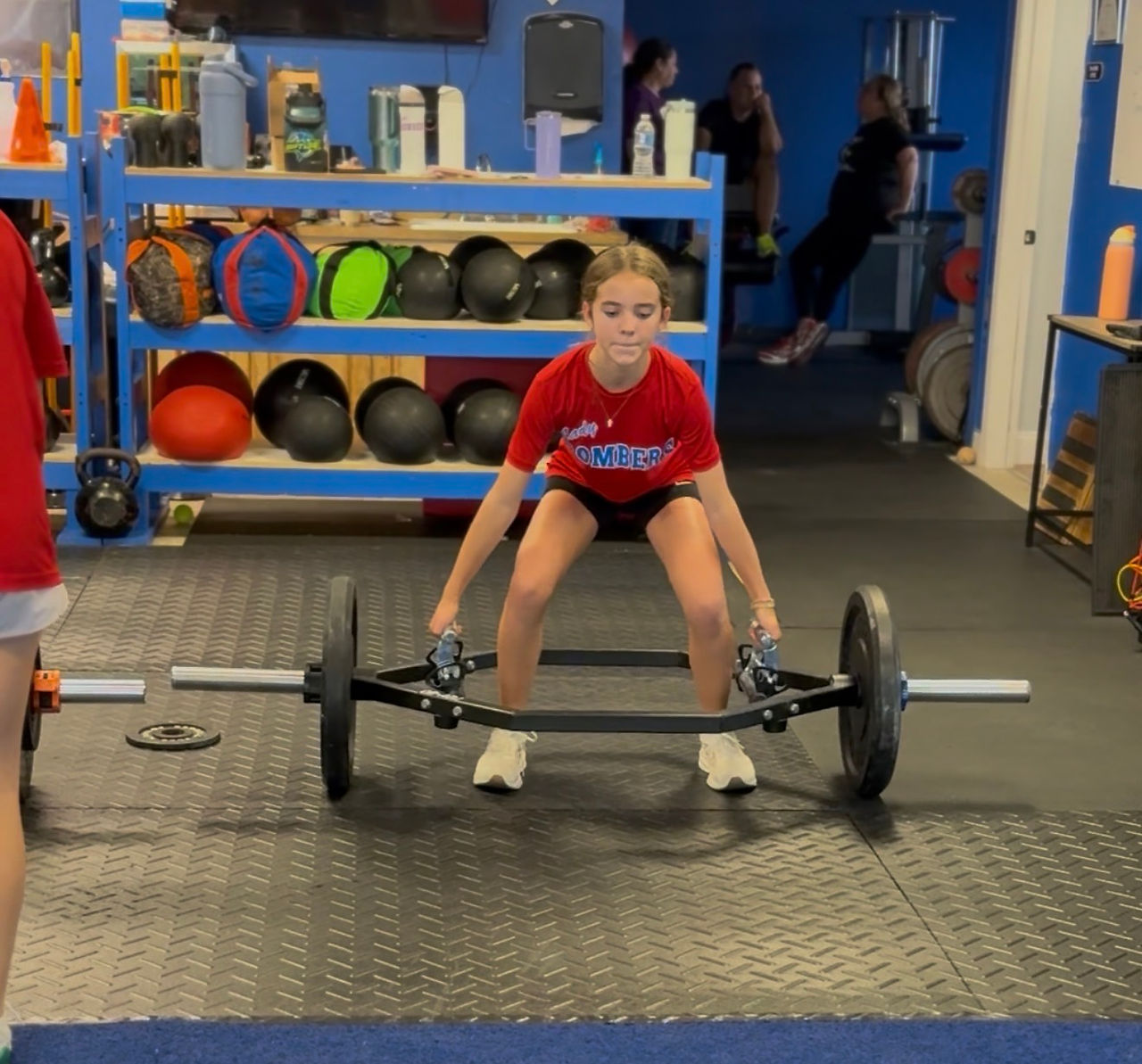
Team practice exists to build a team. A coach with 18 kids and 90 minutes runs plays, installs defense, builds situational awareness, and gets a roster ready for Saturday. That is what practice is supposed to do, and a good coach does it well.
Practice isn't built to develop the athlete's physical engine. In a full season of practices, most student-athletes never get:
Progressive Loading A structured plan where resistance increases over weeks and months so the body actually adapts and gets stronger
Sprint Mechanics Coached acceleration and top-end running form, not just “run harder”
Deceleration & Landing Mechanics The ability to stop, absorb force, and change direction under control
Single-Leg & Rotational Strength The way almost every sport is actually played
Correction of Imbalances The left-right and front-back asymmetries that quietly become injuries
Individual Attention Someone watching your child’s specific movement and coaching it
A hundred more ground balls will make your athlete better at fielding ground balls. It will not make them faster to the ball. That is a different adaptation, and it comes only from explosive power, reaction time, and other training essentials designed to produce it.
More volume without more strength isn’t development. It’s exposure.
Here is the part that keeps us up at night.
When a parent adds a second team, the athlete’s workload increases significantly: more sprinting, more cutting, more jumping, more throwing, more collisions, more pounding on a body that is still growing. And when that workload spikes, strength-and-conditioning training gets cut.
Think about what that actually means. You have increased the body's demand and removed what was preparing it to handle it. Stronger tissue, better landing mechanics, better deceleration control, and balanced musculature let an athlete absorb a heavy season. Take those away and add volume, and you are not building an athlete. You are just exposing one.
Take those away and add volume, and you are not building an athlete. You are just exposing one.
The tired athlete in month three of a double season, running on an unstrengthened body, is the athlete who tweaks a hamstring in a meaningless game, whose knee starts talking to them, or who quietly loses a step and no one can explain why.
Strength and conditioning is not the thing you drop when the season gets heavy. It's what makes a heavy season survivable.
The Gap You Can’t See Yet
At 10, 11, and 12, sports mostly reward whoever hit puberty first and whoever has the best natural coordination. Talent carries the day, and it is easy to watch your kid dominate a rec league and conclude they are set.
Then something happens between 13 and 16...
The physical playing field levels out. Everyone grows. Now the deciding factor isn't who was born fast; it is who spent those years building strength, power, and body control while everyone else was just playing games.
This is the part parents don't see coming, because the gap doesn't open all at once. It opens a half-step at a time over two or three years, and then one day your athlete is at tryouts, standing next to a kid who is visibly more powerful, gets to top speed more quickly, changes direction more sharply, and does not fade in the fourth quarter. That kid did not get more talented. That kid trained.
And here is the uncomfortable truth of youth sports right now: roster spots are finite. When two athletes have similar skill, the more physically developed one takes it. Every time.
When two athletes have similar skill, the more physically developed one takes it. Every time.
Talent Is the Entry Ticket, Not the Advantage
Competitive youth sports have changed. Twenty years ago, being naturally gifted was enough to carry an athlete through high school. Today, at the level where kids are competing for varsity spots, showcase invites, club rosters, and college looks, nearly everyone in the room is talented. Talent is the price of admission, not the differentiator.
Talent is the price of admission, not the differentiator.
What separates athletes now is preparation, the one variable your family can fully control. Your child cannot choose their genetics, their growth curve, or their birthday. They can absolutely choose to be the strongest, most explosive, most durable version of themselves.
We have watched it happen in our gym over and over: the kid who was never the most naturally gifted athlete on the field methodically closes the gap, then passes the kids who coasted. Not because of a secret program. Because they showed up twice a week for two years and got measurably stronger while everyone else was just playing.
What “Just a Few Months Off” Actually Costs
When parents pause for a season, they are usually picturing a pause button. In reality, it works more like a slow leak.
Strength and power qualities begin to decline within weeks without training stimulus. Coordination and movement patterns that were becoming automatic get rusty. The training habit, arguably the most valuable thing we build in a 13-year-old, breaks, and habits are much harder to restart than to maintain.
So the athlete who comes back after a four-month “break” does not resume where they left off. They spend the first several weeks rebuilding ground they already owned. Do that once a year, every year, and your athlete runs in place during the exact window when their peers are compounding gains.
Meanwhile, the athlete who stays consistent, even at reduced volume, during the busiest stretch of the season keeps every bit of ground they earned and keeps stacking on top of it.
You Don’t Actually Have to Choose
Here is what we want every parent that has enrolled their student at the Strength & Performance Institute to understand: the choice is almost never “club team or strength training.” It is a scheduling and time management problem being treated like a priorities problem.
In-season training does not look like off-season training. When your athlete’s competition load increases, the smart move is to adjust training, not eliminate it. That can mean:
Decreasing Sessions Dropping from three sessions a week to two, or even one, to maintain what they have built.
Shift Focus Instead of focusing on building maximum strength, reprioritize the goal to maintaining strength, power, and movement quality.
Decrease Total Volume Reduce total volume so training supports game-day performance instead of competing with it.
Train For Athlete Support Use training sessions as the athlete's active recovery and injury-prevention work during the heaviest part of the schedule.
One quality session a week during a packed season will preserve far more than zero sessions will. Consistency over years is what builds an elite athlete, not intensity in the two months when the calendar happens to be clear. Talk with your head training coach about readjusting your athlete's focus so their programming matches their needs.
What This Looks Like at SPI
Our Strength, Speed & Agility classes are built for exactly this reality. They are small-group, coached by people with real athletic and strength-coaching credentials, and run in a private, distraction-free facility, not a warehouse full of kids counted rather than coached to meet KPI sales goals reported to corporate.
We are also an education-first gym. We teach your athlete why they are doing what they are doing, so that by the time they are training on their own in a college weight room, they actually know how to train. Because we take the time to learn each kid's goals and understand their athletic development needs, we can dial their programming up or down based on where they are in their season. While classes aren't as individualized as personal training, we still get to know each athlete personally and can better monitor their workload. We are careful not to overwork or underwork an athlete based on where they are in their season and training needs.
If your athlete just picked up a second team, that is a conversation to have with us, not a reason to disappear until spring. Tell us what their schedule looks like, and we will tell you honestly what the right training dose is for this stretch of the year. Ask questions that will help balance your child as an athlete overall. Yes, we don't want to lose your business, but we too spend the time with your child, putting in the work to watch them excel. The last thing we want is for all that time, effort, and commitment to fall by the wayside because of a scheduling conflict.
The Bottom Line for Parents
If your child plays sports for fun, stays active, and enjoys their Saturday games, that is genuinely great, and there is nothing wrong with that path.
But if your child has told you they want to start on varsity, play in college, or compete at a level above where they are now, then strength and conditioning is not an enrichment activity you fit in when there is room. It is a requirement of the goal they just told you they have. If you are equally committed to your athlete's goals, don't lose sight of that. Their competition is training. The kids taking the roster spots at 16 are the ones who started at 12 and never fully stopped.
The good news is that the barrier is much lower than most parents assume. It is not four days a week. It is not year-round intensity. It is consistency. Showing up, in some form, for years, even during busy seasons, rather than for months.
That is the whole difference. And it is entirely available to your athlete.
Ready to see what consistent training does for your athlete?
About The Strength & Performance Institute
SPI is a veteran-owned private training facility in Clearwater serving student-athletes across Pinellas County, including Dunedin, Safety Harbor, Palm Harbor, Oldsmar, Largo, and beyond. Our Strength, Speed & Agility classes are small-group, appointment-based, and designed for athletes serious about improving their performance and taking their game to the next level.


Comments